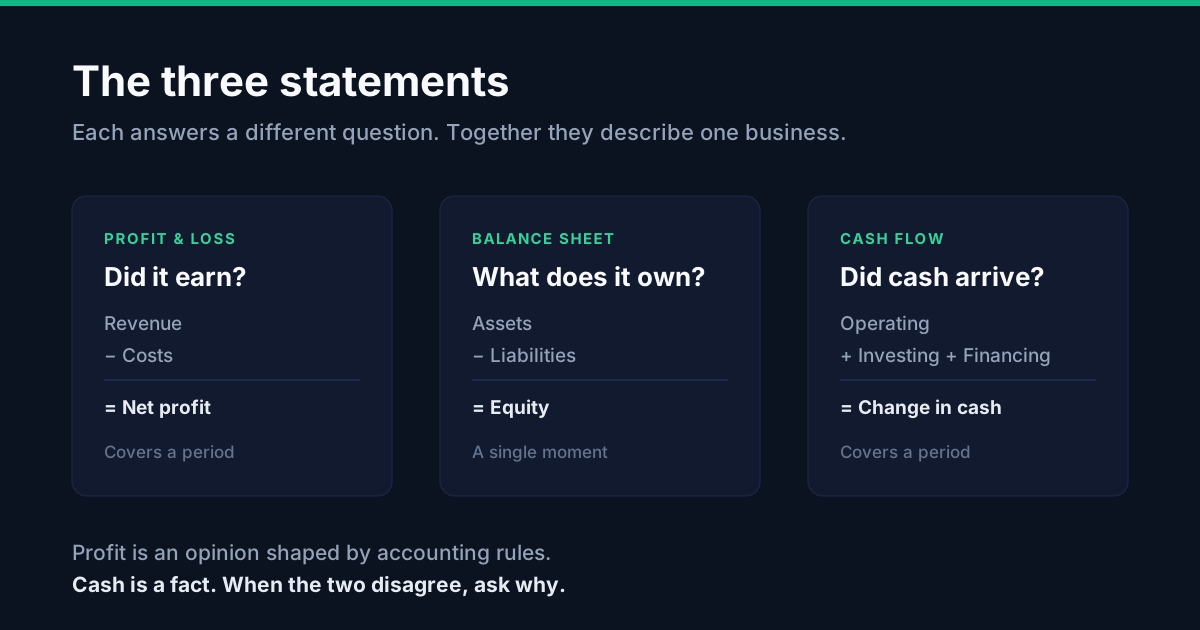
A company's results come in three statements, and each answers a different question. The profit and loss statement asks whether the business earned anything. The balance sheet asks what it owns and what it owes. The cash flow statement asks whether money actually arrived. Read together they describe one business from three angles; read alone, any of them can mislead you.
This guide covers what each one is for, the handful of lines that matter in each, and the specific places where Indian companies' numbers are worth a second look.
Where to find them
Every listed Indian company files results with the exchanges each quarter, and a full annual report once a year. Both are public, free, and published the same day to everyone — trading on what the public cannot yet see is a prosecutable offence.
- Quarterly results land on the BSE and NSE websites under the company's announcements, usually as a PDF a few pages long.
- The annual report is the serious document: the three statements, the notes, the auditor's opinion and the management discussion.
The notes are where the real information lives. The statements tell you the numbers; the notes tell you how the company arrived at them.
The profit and loss statement: did it earn?
This covers a period — a quarter or a year — and runs top to bottom from what came in to what was left.
Revenue is what the company billed. Growth here is the first thing to check, but check why it grew: more units sold is a different business from the same units at higher prices.
Operating profit is revenue minus the costs of actually running the business. Expressed as a percentage of revenue it becomes the operating margin, which is the single most useful number on the page. A company whose revenue rises while its margin falls is buying growth rather than earning it.
Net profit is what remains after interest, depreciation and tax. It is the number the headlines quote, and the one most easily flattered — a one-off gain on selling a property lands here and has nothing to do with the business.
Earnings per share divides net profit by the number of shares. This is the figure that feeds the P/E ratio, and it falls when a company issues new shares even if profit is unchanged.
One habit worth building: read the year-on-year comparison rather than quarter-on-quarter. Many Indian businesses are seasonal — a cement company sells less during the monsoon, a jeweller sells more around Dhanteras — so comparing a quarter to the one before it mostly measures the calendar.
The balance sheet: what does it own?
The balance sheet is a photograph on one date, not a film. It has two sides, and they must agree:
Assets = Liabilities + Equity
What the company controls equals what it borrowed plus what the owners put in and left there. The lines worth your attention:
Debt. Compare total borrowings to annual operating profit. A company earning ₹100 crore of operating profit against ₹800 crore of debt is in a different position from one with ₹80 crore of debt, regardless of how profitable either looks. Debt is also what turns a bad year into a fatal one, because interest does not pause.
Receivables. Money billed but not yet collected. If receivables grow much faster than revenue, the company is booking sales its customers have not paid for. Compare the two growth rates directly — this is one of the most reliable early warnings available to a retail investor.
Inventory. Same logic. Inventory rising faster than revenue usually means goods are not moving.
Cash. Useful, but read it alongside debt. A company holding ₹500 crore of cash and ₹2,000 crore of debt is not sitting on a cushion.
The cash flow statement: did money actually arrive?
This is the one most beginners skip and most professionals read first.
Profit is calculated under accounting rules that involve genuine judgement — when to recognise a sale, how fast to depreciate a machine, what to assume about a bad debt. Reasonable accountants can reach different profits for the same year. Cash is harder to argue with: it either moved or it did not.
The statement has three sections:
| Section | What it covers | What you want to see |
|---|---|---|
| Operating | Cash from the actual business | Positive, and roughly tracking net profit |
| Investing | Buying and selling long-term assets | Negative in a company that is growing |
| Financing | Borrowing, repaying, dividends, share issues | Depends entirely on the stage of the business |
The comparison that matters: operating cash flow against net profit, over several years. If a company reports rising profits while operating cash flow stays flat or negative, something is wrong. The profit exists on paper and the money has not turned up. That gap is where most accounting failures become visible long before anything is announced.
Negative investing cash flow is usually a good sign: it means the company is building. A business that reports growth while investing nothing is either extraordinarily efficient or not actually growing.
Reading all three together
The three statements catch different things, which is precisely why you need all of them.
- A company can show rising profit and falling cash flow — sales booked to customers who have not paid.
- It can show healthy profit and a deteriorating balance sheet — growth funded by debt the P&L does not mention.
- It can show strong cash flow and weak profit — sometimes a sign of heavy depreciation on assets already paid for, which is often fine.
No single ratio substitutes for this. The reason a checklist beats a ratio is that a checklist forces you to look in the places a single number averages away.
Three things to check in ten minutes
If you only have a short time with a results PDF:
- Revenue growth against operating margin. Is the business getting bigger and staying as profitable?
- Operating cash flow against net profit, for the last three years. Do the two move together?
- Debt against operating profit. Could a bad year be survived?
That will not tell you whether a share is worth buying. It will tell you whether the company behind it is healthy, which is the question that has to come first.
FAQ
What is the difference between the profit and loss statement and the cash flow statement?
The P&L records revenue when a sale is made and costs when they are incurred, regardless of when money changes hands. The cash flow statement records money only when it actually moves. A company that sells ₹10 crore of goods on credit shows ₹10 crore of revenue in the P&L and nothing in operating cash flow until the customer pays.
Why do people say cash flow is harder to manipulate than profit?
Profit depends on judgements — when to recognise revenue, how fast to depreciate, what to provide for bad debts — and those judgements can be made aggressively while staying within the rules. Cash either arrived in the bank or it did not. That is why a persistent gap between rising profit and flat operating cash flow is treated as a warning rather than a curiosity.
How often do Indian listed companies report?
Quarterly, with a full audited annual report once a year. Quarterly results are usually unaudited and shorter; the annual report carries the notes, the auditor's opinion and the management discussion, which is where the detail is.
What does it mean if receivables are growing faster than revenue?
It means the company is billing more than it is collecting. Occasionally this is a timing effect or a deliberate change in credit terms to win customers. Sustained over several quarters it suggests sales are being booked to buyers who may not pay, and the profit reported against those sales may never become cash.
Is a company with a lot of debt automatically a bad investment?
No. Debt is a tool, and capital-intensive businesses — power, telecom, infrastructure — routinely carry a lot of it. What matters is whether operating profit comfortably covers the interest, and whether the business is stable enough to keep producing that profit through a weak year. Debt does not cause failure; debt plus a bad year does.
Do I need to read the whole annual report?
Not at first. The three statements, the auditor's opinion, and the notes covering debt, related-party transactions and contingent liabilities will tell you most of what you need. If the auditor's opinion is anything other than clean, stop and read that part carefully before anything else.