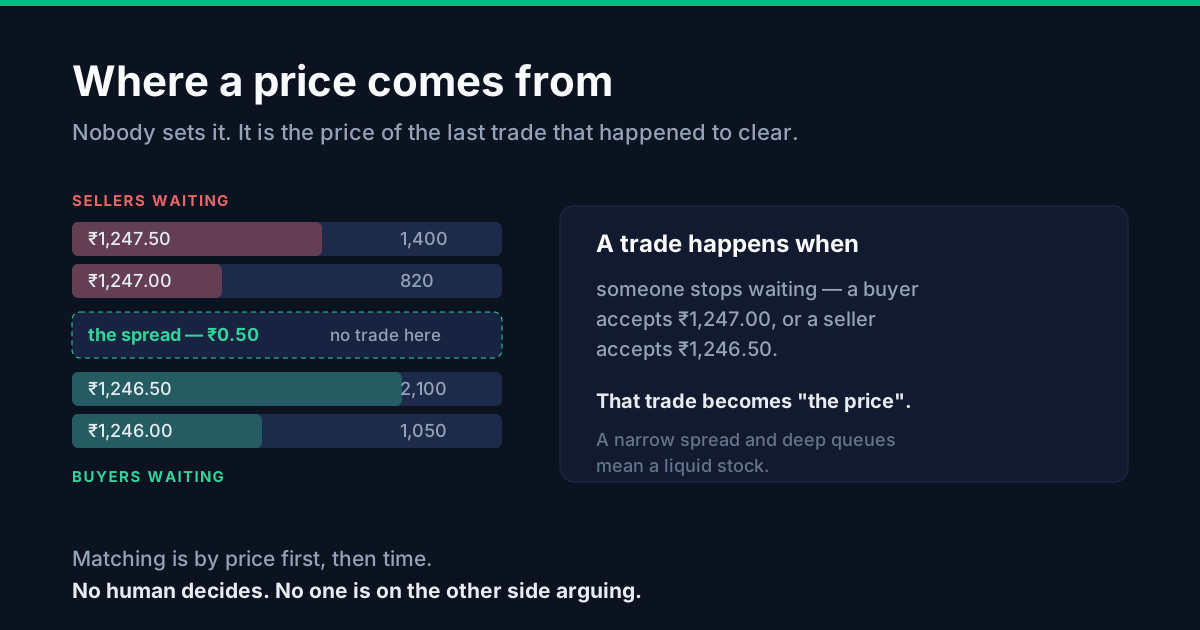
A share price is not set by the company, the exchange, or anyone else. It is simply the price of the most recent trade that cleared — the moment a buyer and a seller agreed. Everything else people talk about, from quarterly results to global interest rates, matters only insofar as it changes what buyers and sellers are willing to agree on.
That sounds pedantic until you watch a stock fall on good news. Then the mechanism becomes the only explanation that works.
The order book, which is where prices actually come from
Every stock on the NSE and BSE has an electronic order book: a live queue of everyone who wants to buy and everyone who wants to sell, with the price and quantity each is willing to accept.
- Bids are buyers waiting, listed highest first.
- Asks are sellers waiting, listed lowest first.
- The spread is the gap between the best bid and the best ask. No trade happens inside it.
A trade occurs when someone stops waiting — a buyer accepts the lowest ask, or a seller accepts the highest bid. That transaction becomes "the price", and the screen updates.
The matching is automatic and follows two rules in order: price first, then time. A better price always goes ahead; among equal prices, whoever queued first goes ahead. No human decides, and nobody is on the other side arguing with you.
Two consequences follow, and both matter more than most beginners expect:
Liquidity is a real property of a stock. Deep queues and a narrow spread mean you can buy or sell a meaningful quantity without moving the price much. Thin queues and a wide spread mean your own order moves the price against you. This is the practical difference between a large-cap and a thinly traded small-cap, and it has nothing to do with whether the business is good.
Your order size interacts with the book. A large order eats through several price levels, so the average price you actually get is worse than the one you saw quoted. The quoted price is only available for the quantity sitting at it.
What makes people change their minds
The book tells you how a price moves. What makes buyers and sellers reprice falls into a few recognisable categories.
Company news. Quarterly results, a large order win, a change of management, a regulatory action. The crucial point is that the price responds to the news relative to what was already expected. A company reporting 20% profit growth can fall hard if the market expected 30%. This is why "good results, stock down" is normal rather than irrational — the good news was already in the price, bought by people who anticipated it.
Sector and macro conditions. Interest rates, commodity prices, currency moves, government policy. A rate cut helps indebted companies and hurts banks' margins; a rupee fall helps exporters and hurts importers. Entire sectors move together because the same fact changes the outlook for all of them.
Flows. Who is buying and selling in aggregate. Foreign institutional investors (FIIs) and domestic institutions (DIIs) move large amounts, and sustained buying or selling by either moves prices regardless of any company-specific news. Index inclusion is the clearest case: when a stock enters the Nifty 50, every index fund tracking it must buy, and that demand is mechanical rather than opinionated.
Sentiment and positioning. Fear and greed are real, and so is the technical reality of who already owns what. A stock that everyone already owns has fewer potential new buyers, which is why crowded positions fall faster when something goes wrong.
Why the price can move with no news at all
Most days, nothing specific happens to a company and its price still moves a percent or two. That is not a mystery:
- Index and fund flows rebalance continuously.
- Derivatives expiry — the last Thursday of the monthly cycle — creates position-squaring that has nothing to do with company fundamentals.
- Liquidity varies through the day. The open and the close are the busiest; the middle of the session is thinner, so the same order moves the price more.
- Someone simply needed the money, or had to deploy it. A fund facing redemptions sells good companies because it must, not because it changed its mind.
A useful discipline follows from this: a 2% move on an ordinary day usually means nothing at all. Treating every wiggle as a signal is how people trade themselves out of good positions.
What does not move the price
Worth stating plainly, because these beliefs are common:
- The company does not set the price, and generally cannot influence it directly. It controls the business; the market prices the business.
- A stock being "cheap" in rupee terms means nothing. A ₹20 share is not cheaper than a ₹2,000 share. The price per share depends on how many shares exist, which is an accident of history. Only the total value of the company, relative to what it earns and owns, means anything.
- Buying pressure from retail investors rarely moves a large-cap. The volumes are not comparable to institutional flows.
Time horizons change the answer
What moves a price over an hour is almost entirely order flow and sentiment. What moves it over a decade is almost entirely the business.
| Horizon | What dominates |
|---|---|
| Minutes to days | Order flow, liquidity, news reactions, derivative positioning |
| Weeks to months | Sector conditions, institutional flows, earnings revisions |
| Years | Actual earnings growth, capital allocation, competitive position |
This is the single most useful thing to internalise about price movement. The daily noise and the long-term outcome are driven by different forces, and confusing the two is the root of a great deal of expensive activity. A business that compounds earnings for ten years will be worth more, and the path there will be jagged for reasons that have nothing to do with the business.
FAQ
Why did a stock fall after good quarterly results?
Because the price already reflected expectations, and the results came in below them. Markets price in what they anticipate; a stock rises or falls on the gap between what was expected and what arrived. Results that are good in absolute terms but weaker than expected are a negative surprise, and the price adjusts to the new expectation.
Who decides the opening price of a stock each day?
Nobody decides it. Indian exchanges run a pre-open session where orders accumulate without matching, and the opening price is calculated as the one that would execute the largest possible volume. It reflects the orders that built up overnight, not a decision by the exchange or the company.
What is the bid-ask spread and why does it matter?
The spread is the gap between the highest price a buyer is offering and the lowest a seller is asking. It is a real cost: buy at the ask and sell at the bid and you lose the spread immediately. Liquid large-caps have spreads of a few paise; thinly traded stocks can have spreads of several percent, which makes frequent trading in them expensive regardless of whether you pick well.
Do FII and DII flows actually move Indian markets?
Yes, particularly at the index level and in large-caps, because the amounts are large relative to daily turnover. Sustained foreign selling can pull the market down while domestic institutions absorb some of it, and the daily FII/DII figures are published for this reason. They explain index-level moves far better than they explain any individual company.
Is a ₹50 stock cheaper than a ₹5,000 stock?
No. The price per share tells you nothing on its own, because it depends on how many shares the company chose to issue. A company worth ₹10,000 crore can have a ₹50 share price or a ₹5,000 one depending purely on share count. What matters is the company's total value compared with its earnings, assets and prospects.
Why does a stock move on a day with no news?
Because trading is continuous and order flow never stops. Funds rebalance, index trackers adjust, derivative positions are squared near expiry, and individual participants buy and sell for reasons of their own. Most small daily moves carry no information about the company at all.