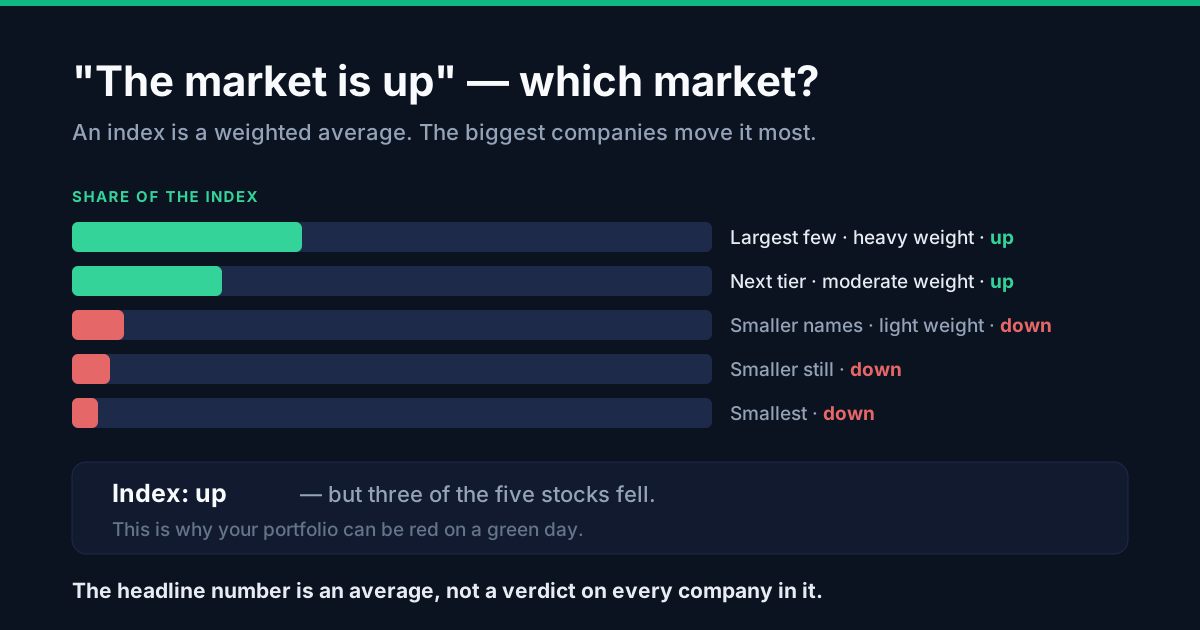
When a headline says the market rose today, it means one number went up — usually the Sensex or the Nifty 50. Both are weighted averages of a small selection of large companies, so "the market" in that sentence is thirty or fifty businesses, weighted by size, standing in for several thousand listed ones. That is why your portfolio can be red on a green day, and why it is not a contradiction.
The two headline indices
| Sensex | Nifty 50 | |
|---|---|---|
| Exchange | BSE | NSE |
| Companies | 30 | 50 |
| Launched | 1986 | 1996 |
| Base | 1978–79 = 100 | 3 Nov 1995 = 1000 |
They track the same economy with a different sample, which is why they move together almost all the time. When they diverge meaningfully over a day, it is usually because a heavyweight sits in one and not the other, or carries a different weight in each.
The base values explain the odd-looking numbers. The Sensex being in the eighty-thousands does not mean shares cost more than they do on the Nifty; it means the Sensex has been compounding from a base of 100 since 1979, while the Nifty started at 1000 in 1995. The level is meaningless on its own. Only the change matters.
How the weighting works, and why it explains so much
Both indices are free-float market-capitalisation weighted. Three ideas sit inside that phrase:
Market capitalisation is the share price multiplied by the number of shares — the total value the market puts on the company.
Free float counts only shares actually available to trade. Promoter holdings, government stakes and other locked-in blocks are excluded. This matters in India, where promoter holdings are often large: a company can be enormous and still carry a modest index weight because most of it is not in public hands.
Weighted means each company influences the index in proportion to that free-float value. The largest few companies can account for a very large share of the index between them, while the smallest constituents barely register.
The practical consequence is the thing most people never have explained to them: the index can rise while most of its own companies fall. If the two or three heaviest constituents are up strongly and twenty smaller ones are down slightly, the weighted average rises. The headline says the market is up. Most of the market, counted by company, is down.
This is also why a single very large company's results can move the whole index, and why "the Nifty is up 1%" tells you remarkably little about whether the stock you own had a good day.
What an index is actually for
Three jobs, all of them useful:
A benchmark. It gives a reference return. If an actively managed fund returns 12% in a year the Nifty returned 15%, the manager destroyed value relative to simply buying the index — and most do, over long periods, which is the entire argument for index funds.
A tradeable instrument. Index funds and ETFs buy the constituents in the index's proportions, and index derivatives let people take a position on the market as a whole. This creates mechanical demand: when a stock enters the Nifty 50, every tracking fund must buy it, regardless of opinion.
A sentiment gauge. A fast, rough answer to "how are large Indian companies doing".
What an index is not is a measure of the whole market. For that you need broader measures — mid-cap and small-cap indices, or market breadth, which counts how many stocks rose versus fell. Breadth is the honest companion to the headline number: an index up 1% with more stocks falling than rising is a very different day from one where nearly everything rose.
Constituents change, and that matters
Index membership is reviewed periodically. Companies that have grown enter; those that have shrunk or been acquired leave.
This produces a quiet upward bias known as survivorship: the index continuously replaces failures with successes. Long-run index returns therefore flatter the experience of someone who bought a fixed basket and held it, because the index itself quietly dropped the losers along the way. That is not dishonest — it is what the index is designed to do — but it is worth knowing when you see a long-term chart.
Inclusion and exclusion also move prices by themselves. The buying is forced and has nothing to do with whether the company became better on the day it was added.
Reading the number sensibly
A few habits that make index moves more informative:
- Check breadth alongside the level. How many stocks advanced versus declined says more about the day than the headline percentage.
- Check which heavyweights moved. A 1% index move driven entirely by one company is a company story, not a market story.
- Compare like with like. If you hold mid-caps and small-caps, the Nifty 50 is not your benchmark. The relevant indices often move quite differently, sometimes for months.
- Ignore the level, read the change. 80,000 versus 24,000 is an artefact of base years, not a statement about value.
FAQ
What is the difference between the Sensex and the Nifty 50?
The Sensex is the BSE's index of 30 companies, launched in 1986 with a 1978–79 base of 100. The Nifty 50 is the NSE's index of 50 companies, launched in 1996 with a base of 1000. Both are free-float market-cap weighted and track the same economy, so they usually move together; the Nifty's wider sample makes it slightly more representative of large Indian companies.
Why is the Sensex number so much higher than the Nifty?
Because they started from different base values in different years. The Sensex has compounded from 100 since 1979; the Nifty from 1000 since 1995. The absolute level reflects that history, not the price of anything. Only the percentage change is comparable between them.
Can the index go up while most stocks go down?
Yes, and it happens regularly. Both indices weight companies by free-float market capitalisation, so the largest constituents dominate. If the heaviest few rise while many smaller ones fall, the weighted average rises even though most constituents declined. Market breadth — advances versus declines — is what reveals this.
What does free-float market capitalisation mean?
Market capitalisation is share price times total shares. Free float counts only the shares genuinely available to trade, excluding promoter and other locked-in holdings. Indian indices weight by free float, so a company with a very large promoter holding carries less index weight than its total size suggests.
What happens to a stock when it is added to the Nifty 50?
Every index fund and ETF tracking the index must buy it to match the index's composition, which creates mechanical demand around the change date. The reverse happens on exclusion. This buying and selling reflects the rules of index tracking rather than any new judgement about the business.
Is the Nifty 50 a good benchmark for my portfolio?
Only if your portfolio looks like it — large Indian companies, weighted roughly by size. If you hold mid-caps, small-caps or a concentrated set of positions, comparing yourself to the Nifty 50 will mislead you in both directions, because those segments routinely move differently for extended periods. Use an index that matches what you actually own.