A stock market is a regulated marketplace where people buy and sell small ownership shares in companies. When you buy one share of Reliance, you own a genuine, if tiny, slice of the business — its factories, its profits, its losses. India's market is built on two exchanges: the BSE, founded in 1875 and the oldest in Asia, and the NSE, which began electronic trading in 1994 and now handles the bulk of the country's volume.
That is the whole idea in three sentences. The rest of this piece explains how it actually works, and why the history matters more than most beginners expect.
What a stock market actually does
Strip away the screens and the shouting, and a stock market solves one problem: a company needs money to grow, and savers need somewhere to put money that might grow.
A company that wants capital can borrow it, which means paying interest regardless of how business goes. Or it can sell a piece of itself. Selling a piece is the stock market's business. The company raises money once, in an IPO, and in exchange the buyers get a permanent claim on whatever the business earns from then on.
What happens afterwards is the part people confuse. When you buy Infosys shares today, Infosys receives nothing. You are buying from another investor who wants out. The company raised its money long ago; what you are trading is the claim.
This secondary trading is not a sideshow. It is what makes the original investment possible. Nobody would fund a company for thirty years if there were no way to change their mind. A market that lets you sell on Tuesday is what persuades you to buy on Monday. Economists call this liquidity, and it is the single most valuable thing an exchange provides.
How a trade works in India today
Say you want 10 shares of HDFC Bank.
- You place an order through a broker — Zerodha, Groww, ICICI Direct. Brokers are members of the exchange; you are not.
- The order reaches the exchange, where it joins an electronic order book: every buy and sell offer, ranked by price.
- The exchange matches you with a seller willing to take your price. No human negotiates this. The matching engine pairs orders in microseconds, by price first and time second.
- Clearing and settlement follow. A clearing corporation steps between buyer and seller and guarantees both sides. Shares land in your demat account, money leaves your bank.
That last step used to take a fortnight. Today it is same-day or next-day, and the shares exist only as electronic entries — no certificates, no signatures, no forgery.
Two details worth holding onto. First, the price is not set by anyone. It is simply the price of the last trade that happened to clear. Second, the exchange never takes a side. It runs the venue and guarantees settlement; it has no opinion on whether HDFC Bank is worth buying.
Where it came from: a banyan tree in Bombay
In the 1850s, a handful of brokers met under a banyan tree near Bombay's Town Hall to trade shares in cotton and bank companies. There was no building, no rulebook, no regulator. As the group grew, it moved — repeatedly, as it outgrew each spot — until in 1875 the brokers formalised themselves as The Native Share & Stock Brokers' Association.
That association became the Bombay Stock Exchange. It is the oldest stock exchange in Asia, and the street it eventually settled on is still called Dalal Street — dalal being the Gujarati and Hindi word for broker.
For most of the next century, the BSE operated by open outcry: brokers standing in a ring, shouting and signalling with their hands. It worked, after a fashion, and it had a defining flaw. Only people in the room could trade. If you lived in Coimbatore or Guwahati, you placed your order with a local broker, who relayed it to Bombay, and you took whatever price you were told you got. You had no way to verify it.
That information gap was not a bug anyone was in a hurry to fix. It was where a great deal of the money was made.
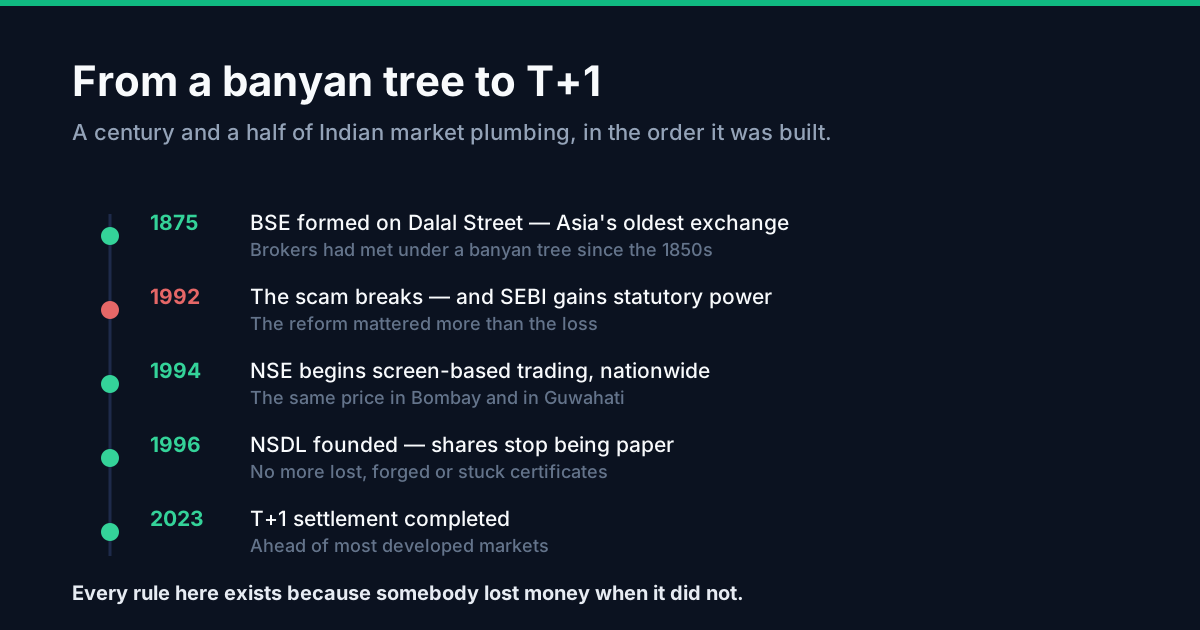
The timeline that changed everything
| Year | What happened | Why it mattered |
|---|---|---|
| 1875 | BSE formally established | Asia's first stock exchange |
| 1986 | Sensex launched | India finally had a single number for "the market" |
| 1988 | SEBI created | A regulator at last — though without legal teeth |
| 1992 | Harshad Mehta scam breaks | ₹4,000 crore siphoned via bank receipts; the market collapses |
| 1992 | SEBI Act passed | SEBI gains statutory power to investigate and punish |
| 1994 | NSE begins equity trading | Screen-based, nationwide, anonymous |
| 1996 | Nifty 50 launched; NSDL founded | A rival index, and the start of paperless shares |
| 2000–01 | Derivatives introduced | Index futures, then options |
| 2003 | T+2 settlement | Trade Monday, settle Wednesday |
| 2023 | T+1 settlement completed | India ahead of most developed markets |
Two entries deserve more than a row.
The 1992 scam was the turning point. Harshad Mehta, a well-known broker, exploited gaps in the way banks settled government securities to pull roughly ₹4,000 crore into the stock market, driving prices to levels nothing justified. When it unravelled, the market fell hard and ordinary investors were wiped out. The lasting consequence was not the loss — it was the reform. SEBI received real statutory powers that same year, and the political will appeared to build an exchange that could not be run as a private club.
The NSE was that exchange. When it started trading equities in 1994, it did something the BSE's floor could not: it put the same screen in Bombay and in Guwahati. Your order competed with everyone else's on price, not on who your broker drank with. Within a few years the BSE had abandoned open outcry and gone electronic too. Competition did in half a decade what a century of self-regulation had not.
What changed for ordinary investors
Three reforms, between the mid-1990s and today, did more for the retail investor than any bull run.
Dematerialisation. Before NSDL in 1996, a share was a piece of paper. Papers get lost, forged, and stuck in transfer for months. Today your holdings are electronic entries at a depository — unforgeable, and transferred the day you sell.
Shorter settlement. The old system ran on a fortnightly cycle with carry-forward positions, which blurred the line between investing and betting. Rolling settlement ended it. India moved to T+1 in phases, completing in January 2023 — ahead of most developed markets, including the US at the time.
Information parity. Companies must disclose material news to the exchange, which publishes it to everyone at once. Trading on what the public cannot know is a prosecutable offence.
The combined effect shows up in the numbers. Demat accounts in India crossed 10 crore — 100 million — in August 2022, having roughly tripled in three years. A market that was a Bombay broker's club within living memory is now something a college student opens on a phone in an afternoon.
What this history should teach you
Three things, and none of them is a stock tip.
The rules you trade under were written in blood. Every settlement rule and disclosure requirement exists because somebody lost money when it did not. The system is not bureaucratic by accident.
Access is not the same as advantage. The screen is identical for everyone, which is exactly why the edge moved. It is no longer in getting the price; it is in understanding the business behind it. That is harder, and it is where retail investors most often skip the work.
Crashes are a feature of the instrument. 1992, 2001, 2008, 2020 — the market has fallen hard roughly once a decade and recovered each time. Anyone promising equity returns without equity volatility is selling you something.
FAQ
What is the difference between the BSE and the NSE?
Both are stock exchanges where the same shares can be traded. The BSE, founded in 1875, is Asia's oldest and uses the Sensex as its headline index. The NSE, which began equity trading in 1994, introduced nationwide electronic trading and uses the Nifty 50. The NSE handles a substantially larger share of equity and derivatives volume today. Most large companies list on both.
Who regulates the stock market in India?
The Securities and Exchange Board of India (SEBI). It was set up in 1988 but had no statutory power until the SEBI Act of 1992, passed in the aftermath of the Harshad Mehta scam. SEBI oversees exchanges, brokers, mutual funds and listed companies, and can investigate, fine and bar market participants.
Why did the stock market go electronic?
Because open outcry could only include the people physically in the room, which meant investors elsewhere could not see the real price. When the NSE launched screen-based trading in 1994, the same order book became visible nationwide. The BSE followed, and floor trading ended.
What does T+1 settlement mean?
It means a trade settles one working day after it is executed: buy on Monday, and the shares are in your demat account on Tuesday while the money leaves your bank. India completed its move to T+1 in January 2023, ahead of most developed markets. The older cycle took days or, before rolling settlement, as long as a fortnight.
Do I own part of the company when I buy a share?
Yes, legally. One share of a company with ten crore shares outstanding makes you a ten-crore-th owner, with a proportional claim on profits and a vote at the AGM. What you do not get is any say in daily operations, and in practice a small holder's vote does not move decisions.
Is the stock market the same as gambling?
They share one feature — an uncertain outcome — and differ in the one that matters. A casino game has a fixed negative expected value: play long enough and you lose by design. A share is a claim on a business that produces goods, earns money and can grow. Over long periods Indian equities have produced real returns because the underlying businesses grew. That said, buying a stock you have not researched, in the hope the price rises, is closer to gambling than investing, whatever the instrument.