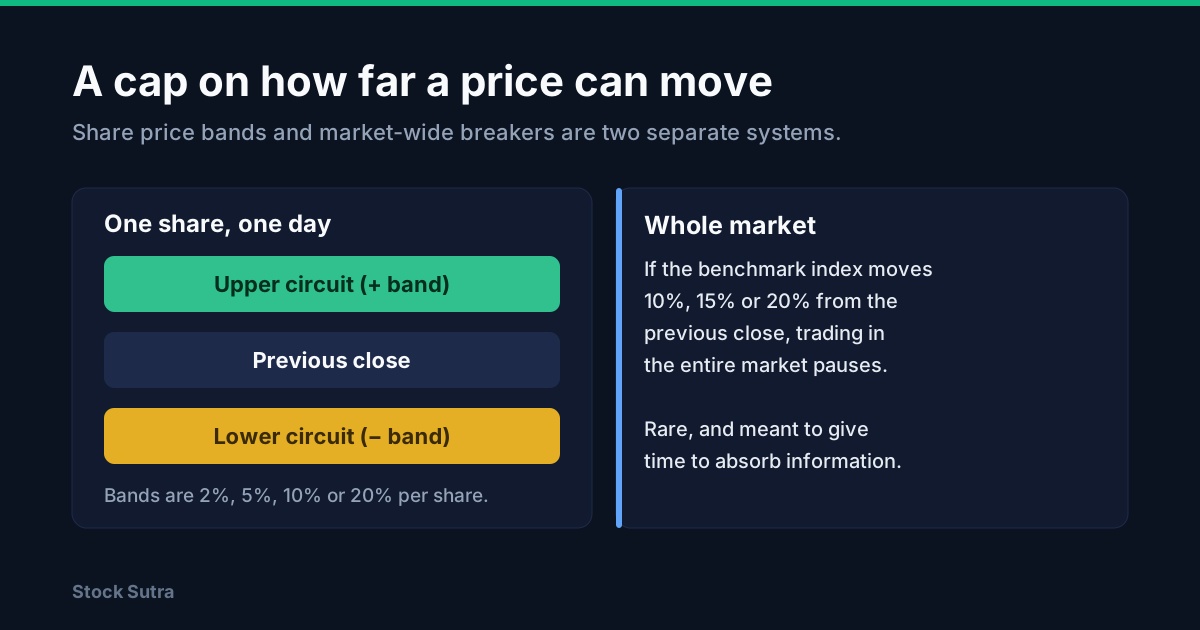
A circuit limit is a cap on how far a price is allowed to move in one day. When a share or an index touches the cap, trading in it is restricted or paused until the exchange's rules allow it to continue. The purpose is to slow panic, not to prevent price changes.
There are two separate systems, and they are often confused. One applies to individual shares. The other applies to the whole market, using the main indices.
Price bands on individual shares
Each share has a price band, a percentage the price may rise or fall from the previous day's close in a single session. Common bands are 2%, 5%, 10% and 20%, with some shares carrying no band at all.
When a share reaches the top of its band it is in the upper circuit, and when it reaches the bottom it is in the lower circuit. In either case, no trade can take place beyond that price on the day. Orders can still be placed, which is where the characteristic sight arises: a stock stuck at its upper circuit has buyers waiting and almost no sellers, and one stuck at its lower circuit has the reverse.
A few points follow from this:
- The band is set by the exchange for each share. It depends on factors such as how actively and how reliably the share trades, and exchanges can move a share to a narrower or wider band. A share you remember on a 20% band may now be on a different one.
- Hitting a circuit does not mean good or bad news. It means the order book is lopsided at that moment. The reasons range from genuine news to thin trading.
- A tight band limits how quickly you can exit. In a lower circuit there may be no buyers, so a sell order can sit unfilled until the next session.
- Shares in the derivatives segment generally have no fixed band. Instead they follow other volatility controls, so the absence of a circuit does not mean the absence of limits.
Market-wide circuit breakers
The second system watches the main indices rather than individual shares. If the benchmark index falls or rises sharply in one day, trading in the entire equity and derivatives markets is paused.
The triggers are set at three levels of movement from the previous close: 10%, 15% and 20%. How long the pause lasts depends on the level reached and the time of day at which it is triggered, and the longer the day has left to run, the longer the pause tends to be. At the highest level, trading can end for the day.
These halts are rare. They exist to give participants time to take in information and to let orders and margin calls be sorted out in an orderly way, so that a fall does not feed on itself at speed.
Why exchanges have limits at all
Two reasons explain the design.
Fast moves feed on themselves. When prices drop sharply, forced selling by leveraged participants pushes prices lower, which triggers more forced selling. A pause breaks the chain and gives time for margin to be arranged and for information to spread.
A limit protects against errors and manipulation. A wrongly entered order or a deliberate attempt to push a thinly traded share around is limited by the maximum distance it can move in a day.
The trade-off is real. A limit does not remove selling pressure. It delays it, and in a share stuck at its lower circuit, the delay can mean waiting a session or more to exit. This is the practical cost for anyone holding a thinly traded share.
How it connects to what you see on screen
When you see a share at the upper circuit, the quoted price is the highest it is allowed to trade at that day, not necessarily the price it is worth. When you see a large pending buy order and no sellers, the book is lopsided. Neither fact explains why, and neither predicts the next session.
Where to check the facts
Bands change, so for a specific share the current value is in the exchange's own data:
- The price band shown on the share's quote page on the exchange website
- The circuit breaker thresholds and durations in the exchange's market-wide circuit breaker notice
- The list of shares with special bands or surveillance measures, published by the exchanges
Frequently asked questions
What is the difference between an upper circuit and a lower circuit?
An upper circuit is the highest price a share may trade at on a given day, and a lower circuit is the lowest. They are measured from the previous close.
Does a lower circuit mean a company is in trouble?
Not by itself. It means sellers outnumbered buyers at the permitted price. The reason may be company news, but it can also be the result of thin trading or market-wide selling.
Can I always sell a share that is in the lower circuit?
No. If there are no buyers at the permitted price, a sell order may stay unexecuted. Orders carry over only according to the exchange's rules for that order type.
What triggers a market-wide halt?
A movement of 10%, 15% or 20% in the benchmark index from the previous close. The length of the pause depends on the level and the time of day.
Are circuit limits the same on every exchange and for every share?
No. Bands are set per share and can be revised by the exchange, so the current band should always be read from the exchange's own page.