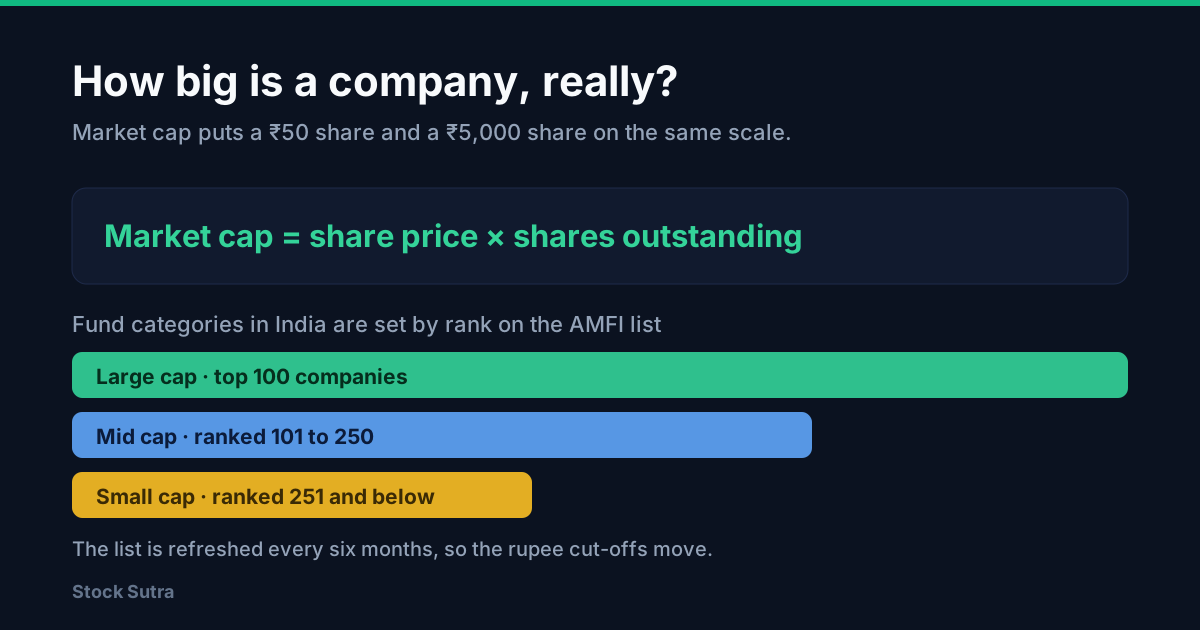
Market capitalisation, or market cap, is the total value the stock market puts on a company's shares. It is calculated by multiplying the current share price by the number of shares the company has issued. It is the standard way of saying how big a listed company is, and it is the basis of the labels large cap, mid cap and small cap.
It measures size by what the market currently thinks the whole company is worth. It is not the same as how much the company earns, owns or has raised.
How it is calculated
Market cap = share price × total number of shares outstanding
A company with 10 crore shares trading at ₹500 has a market cap of ₹5,000 crore. If the price rises to ₹600, the market cap rises to ₹6,000 crore, even though nothing about the company's operations changed that day.
This is why the share price on its own says nothing about size. A ₹50 share of a company with 500 crore shares is a far larger company than a ₹5,000 share of a company with 1 lakh shares. Market cap puts both on the same scale.
Full market cap and free-float market cap
There are two versions, and they differ in a way that matters.
- Full market cap counts every share the company has issued, including those held by promoters and other long-term holders.
- Free-float market cap counts only the shares actually available for the public to trade. Shares held by promoters, governments and strategic investors are excluded.
Index providers generally weight companies by free-float market cap, because it reflects what can really be bought and sold. The large, mid and small cap labels used by mutual funds are based on the full market cap ranking.
How India decides who is large, mid or small
The labels are not set by any one company's own size in rupees. They are set by rank. SEBI requires mutual funds to follow a common definition, and the industry body AMFI publishes the list:
- Large cap: the top 100 companies by full market cap
- Mid cap: ranked 101 to 250
- Small cap: ranked 251 and below
AMFI refreshes the list every six months, using an average of the preceding months' market caps. A company can move between categories at a refresh, and nothing about the business has to change for that to happen. A rising market lifts everyone and the rank order can shift, so a company can be reclassified while its own value barely moved.
Because the categories are rankings, the rupee cut-offs between them move over time. A figure you read in an older article will be out of date, so the current list on the AMFI website is the reliable reference.
Why the categories matter
The labels matter mostly because of how funds use them. Mutual fund categories such as large-cap and mid-cap funds must hold a minimum share of their portfolio in the matching group, which makes the definition operational rather than a loose description.
They also describe a general character that holds on average but not for every company:
- Large caps are established and widely followed, and their shares usually trade in high volumes.
- Mid caps are growing companies that have moved beyond the smallest scale.
- Small caps have smaller businesses and usually thinner trading, so their prices can move more sharply on less volume.
These are tendencies, not rules. There are large caps that are risky and small caps that are well run. Size describes how big the market values a company, not how good the business is.
What market cap does not tell you
It does not tell you the company is cheap or expensive. A large market cap can be fair for a very profitable business and too high for a weak one. Valuation needs a comparison with earnings, assets or cash flow.
It does not tell you about debt. Market cap counts only the shares. A company with a large debt has a different financial position from one with none, even at the same market cap. Enterprise value, which adds debt and subtracts cash, covers this.
It moves with the price every day. Because it is the price times the share count, any rise or fall in the share price changes it immediately.
Where to check the facts
- The AMFI list of large, mid and small cap companies, published twice a year
- The exchange website, which shows the current market cap of each listed company
- The company's filings, for the number of shares issued
Frequently asked questions
What is market capitalisation in simple words?
The total value the market places on a company: the share price multiplied by the number of shares it has issued.
What makes a company a large cap in India?
Ranking in the top 100 listed companies by full market capitalisation, according to the AMFI list that mutual funds follow.
Can a company move from mid cap to large cap without growing?
Yes. The categories are based on rank, so a company can be reclassified when others rise or fall around it.
Is a small-cap company the same as a risky company?
No. Small cap describes size. Riskiness depends on the business, its debt and its trading liquidity, not on the label alone.
What is the difference between market cap and free-float market cap?
Market cap counts all issued shares. Free-float market cap counts only those available for the public to trade, excluding promoter and other locked-in holdings.