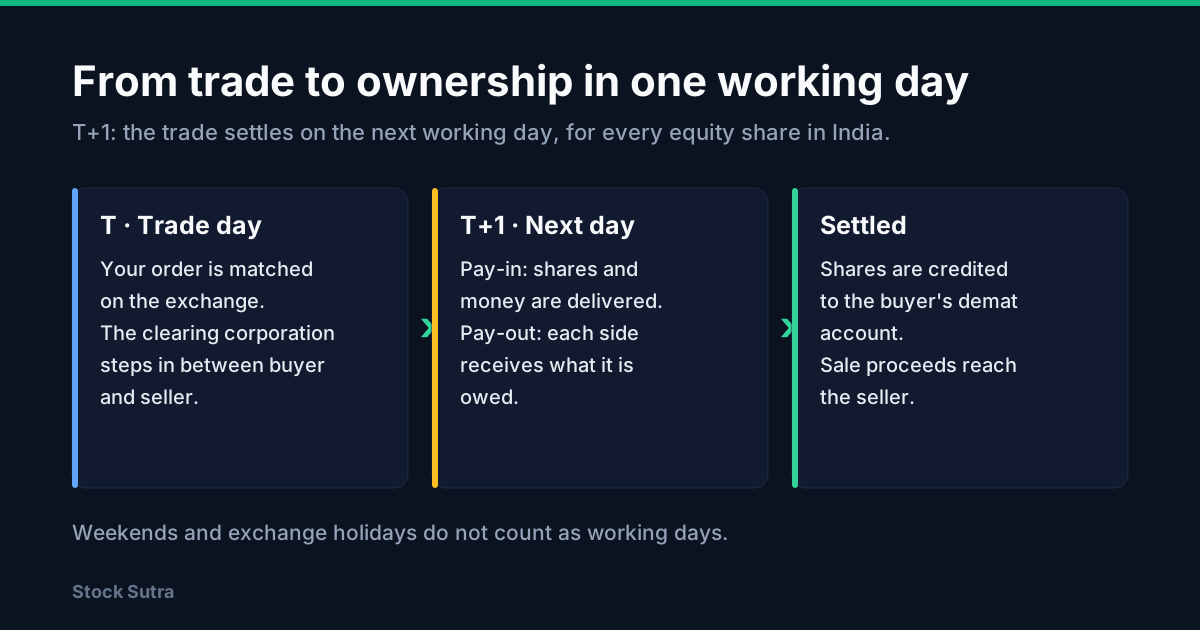
Settlement is the step that turns a trade on the screen into a real change of ownership: the buyer's money reaches the seller, and the seller's shares reach the buyer. In Indian equities this happens one working day after the trade, a system known as T+1, where "T" is the trade day.
Most investors never see settlement happen, because the broker, the exchange and the depositories handle it behind the scenes. Knowing how it works explains why shares appear in your account the next day, why a sale's proceeds are not always available instantly, and what a "failed" delivery means.
From a click to a trade
When you place an order, your broker sends it to the exchange, where it is matched with an opposite order. At that moment a trade exists, with a price and a quantity. But nothing has moved yet. The trade is a binding obligation: one side must deliver shares, the other must deliver money.
The exchange passes the trade to its clearing corporation, which stands in the middle of every trade. It becomes the buyer to every seller and the seller to every buyer, so neither side depends on the other's good faith. Its job is to make sure that settlement actually completes, and it holds back-up in the form of margins and a settlement guarantee fund.
What happens on T and on T+1
On T, the trade day:
- Orders are matched and trades are created.
- The clearing corporation works out each broker's net obligation: how many shares of each stock it owes or is owed, and how much money.
On T+1, the next working day:
- Brokers deliver the shares they owe and the money they owe into the clearing system. This is the pay-in.
- The clearing corporation sends shares to the buyers' brokers and money to the sellers' brokers. This is the pay-out.
- Shares are credited to the buyer's demat account and sale proceeds become available to the seller's trading account.
Weekends and exchange holidays do not count. A trade on Friday settles on Monday, and a trade before a holiday settles after it.
When India moved to T+1
India used to settle two working days after a trade, then moved to one. The change was introduced in stages and was completed for all equity shares on 27 January 2023. India was one of the first large markets to settle this quickly. An optional same-day settlement option, T+0, was later introduced as a limited pilot for a set of shares.
The shorter cycle means money and shares are locked up for less time, and the risk that something changes between the trade and its completion is smaller.
What it means for you in practice
Your shares arrive the next working day. A purchase made today shows in your demat holdings after settlement, not instantly, though your broker's app usually shows the position straight away.
Sale proceeds follow the same timing. The money from a sale is settled on T+1. Many brokers let you use part of the sale value for new trades sooner, but that is a facility the broker provides against its own risk, not the settlement itself.
Selling shares you have not yet received is a short-delivery risk. If you buy a share and sell it before it reaches your demat, the shares may not be there to deliver at settlement. Brokers offer products for this, but the underlying issue is the same: settlement has not completed.
Dividends and corporate actions follow the same shorter cycle. Because ownership is determined at settlement, the date from which a buyer stops being entitled to a dividend is tied to it. The article on dividends explains that connection.
What a failed settlement means
Sometimes the seller's side does not deliver shares by the deadline. The exchange then runs an auction to buy the shares in the market, and the cost is charged to the party that failed to deliver. The buyer is not left without shares or money. The clearing corporation's job is to make the buyer whole, either by delivering shares from the auction or, where that is not possible, by paying a close-out amount.
This is why exchange-traded settlement is considered safe for ordinary investors. The risk of the person on the other side not honouring the trade is taken by the clearing corporation, not by you.
Where to check the facts
The exact timetable, cut-off times and rules are set by SEBI and the exchanges and are revised from time to time. The reliable sources are:
- The exchange and clearing corporation circulars on settlement
- Your broker's contract note, which shows the trade date and settlement date for each trade
- The depository statement that records the shares in your demat account
Frequently asked questions
What does T+1 mean?
The trade settles one working day after the trade day. A trade made on a Tuesday settles on Wednesday.
Do weekends count?
No. Only working days count, so a Friday trade settles on the following Monday unless that is a holiday.
When can I use the money from a sale?
Settlement happens on T+1. Brokers often let you use part of it earlier as a facility of their own, but the settled funds arrive on T+1.
Is there anything faster than T+1?
An optional same-day cycle, T+0, was introduced as a limited pilot for a set of shares. T+1 remains the standard.
What happens if the seller does not deliver the shares?
The exchange runs an auction to obtain the shares and charges the cost to the seller who failed to deliver. The buyer is protected by the clearing corporation.