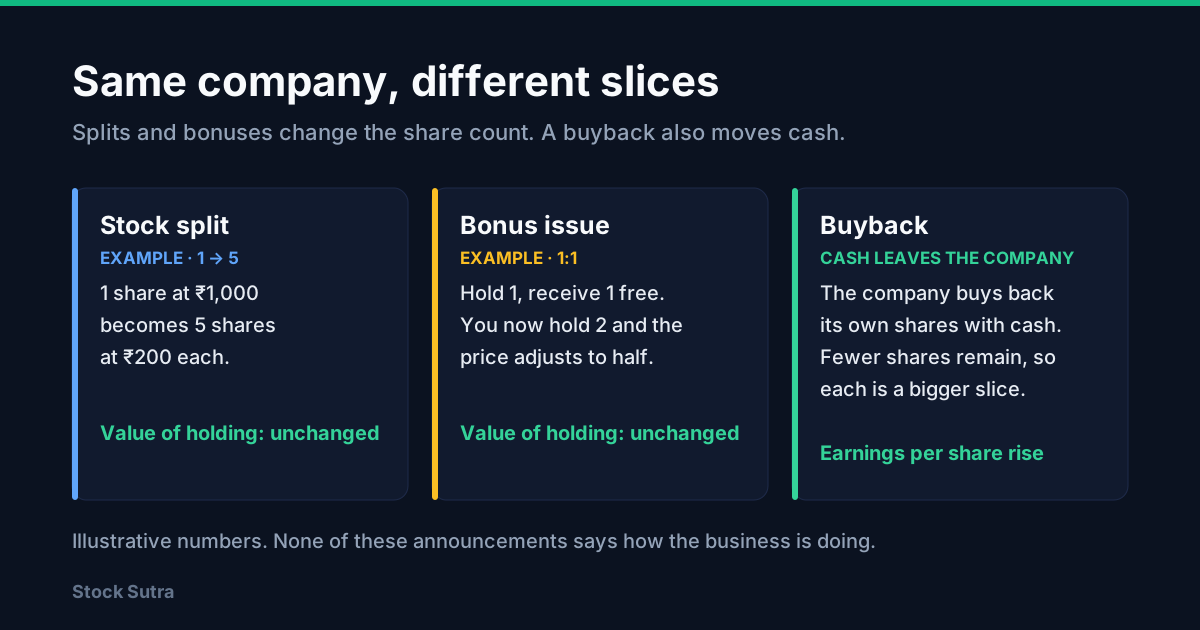
Companies sometimes change the number of their shares or buy their own shares back. Three actions are the most common: a stock split, a bonus issue and a buyback. They sound similar, they are often reported together in the same headline, and they do quite different things to the shares you hold.
The one idea that unlocks all three is that a company's total value is not created or destroyed by cutting the same pie into more or fewer slices. What changes is the number of shares, the price of each and, in a buyback, the cash that leaves the company.
Stock split: the same pie, more slices
A stock split divides each existing share into several shares of a lower face value. In a 1-for-5 split, a share with a face value of ₹10 becomes five shares of ₹2 each.
- You hold five times as many shares.
- The market price of each share falls to about one-fifth of what it was.
- The total value of your holding is unchanged, because five shares at a fifth of the price are worth the same as one at the old price.
Nothing about the business changes. No cash enters or leaves the company, and its profits, assets and debts are exactly what they were. The usual reasons given are to make the price per share lower and shares easier to trade in smaller amounts. A lower price per share does not make a company cheaper. A ₹50 share is not a bargain compared with a ₹5,000 share, because the price per share depends on how many shares exist.
A reverse split works the other way, combining shares into fewer with a higher price.
Bonus issue: free shares from the company's own reserves
A bonus issue gives existing shareholders extra shares at no cost, in a stated ratio. In a 1:1 bonus, you receive one extra share for every share you hold. In a 2:1 bonus, two extra shares for each one held.
It looks like a gift, but the arithmetic is the same as a split:
- You hold more shares.
- The price adjusts downward in proportion on the ex-date.
- The total value of your holding does not change.
The company converts part of its reserves into share capital, which is an accounting move rather than a payout. No cash is paid to anyone. The difference from a split lies in that accounting treatment, not in what the shareholder ends up with.
Buyback: the company buys its own shares
In a buyback, the company uses its own cash to repurchase shares from the market or from shareholders. The shares it buys are cancelled, so the number of shares outstanding falls.
This is a different kind of action. Money actually leaves the company, and shareholders who sell receive cash. For those who stay:
- The number of shares in existence is smaller, so each remaining share is a larger slice of the company.
- Earnings are spread over fewer shares, so earnings per share rise, other things equal.
- The company has less cash than before, which is a cost.
Buybacks can be carried out in two main ways. In a tender offer, the company offers to buy shares at a fixed price from shareholders on a record date, usually at a premium to the market price, and accepts them in proportion to what is offered. In an open-market buyback, it buys gradually through the exchange. The tender route usually has an entitlement ratio for small shareholders, which the offer document sets out.
The tax treatment of buybacks has changed in recent years, so check the current rules before relying on any description.
What changes and what does not
| Stock split | Bonus issue | Buyback | |
|---|---|---|---|
| Number of shares you hold | Rises | Rises | Falls, if you tender |
| Price per share | Falls | Falls | Not mechanically changed |
| Cash leaves the company | No | No | Yes |
| Total value of your holding | Unchanged | Unchanged | Cash replaces shares you sell |
Why they are announced
The reasons companies give are practical: wider access to the shares at a lower price per share, rewarding shareholders, returning surplus cash, or signalling confidence. None of these announcements tells you whether the business is performing well. They are a choice of how to structure the capital, and the company's profits, debt and prospects are what decide its value.
Where to check the facts
Each action has dates and terms published by the company and the exchange:
- The corporate announcement to the exchanges, with the ratio, record date and ex-date
- The offer document or public announcement for a buyback, with the price and size
- The corporate actions page of the exchange for the dates
Frequently asked questions
Does a stock split make a share cheaper?
No. The price per share falls, but the number of shares rises by the same factor, so the value of what you hold is unchanged.
Is a bonus issue free money?
You receive extra shares, but the price adjusts down in proportion, so the total value of your holding does not change.
Why does the price drop on the ex-date of a bonus or split?
The same company value is now divided among more shares, so each share is worth proportionally less.
What is the difference between a buyback and a dividend?
A dividend pays cash to every shareholder. A buyback pays cash only to those who sell their shares back, and reduces the number of shares outstanding.
Do these announcements show a company is doing well?
Not on their own. They describe how capital is arranged. The company's profits, debt and business prospects are what matter for its value.