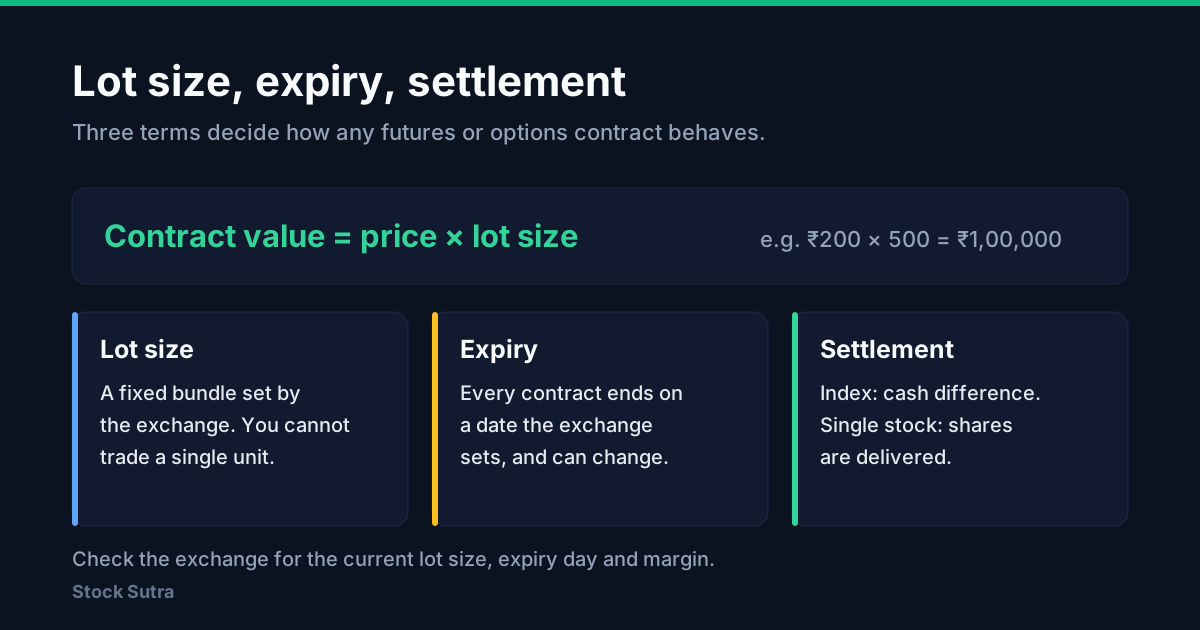
A futures or options contract is an agreement whose value comes from an underlying asset, such as an index or a share. Three terms decide how any contract behaves: the lot size says how much of the underlying one contract covers, the expiry says when the contract ends, and the settlement says what happens on that day.
These three terms are where most surprises in derivatives come from. They are set by the exchanges, and they have changed several times, so the numbers on the exchange's own website always take precedence over anything written here.
Lot size: you trade in fixed bundles
You cannot buy one unit of a derivative contract. Contracts trade in lots, a fixed quantity of the underlying set by the exchange for each instrument. If the lot size for a share is 500, one lot controls 500 shares, and the price of the contract is quoted per share.
So the amount at stake is the quoted price multiplied by the lot size. A futures price of ₹200 with a lot of 500 means a contract value of ₹1,00,000, even though the price on the screen looks small.
Regulators have set a minimum contract value for derivatives, and exchanges revise lot sizes periodically to keep contracts within that range as prices change. This is why a lot size you remember from a year ago may no longer be correct.
Futures and options in one paragraph each
A future is an obligation. The buyer agrees to buy and the seller to sell the underlying at a set price on expiry. Both sides post margin, a deposit that covers daily losses, and gains and losses are settled every day against the day's closing price.
An option is a right, not an obligation. A call gives the buyer the right to buy at a fixed strike price, and a put gives the right to sell at one. The buyer pays a premium up front and can lose no more than that premium. The seller receives the premium but takes on the obligation if the buyer exercises, and must post margin.
Expiry: every contract has an end date
Each contract has an expiry date after which it no longer exists. Exchanges list contracts in a cycle, commonly the current month, the next month and the one after, and for some index products also weekly expiries.
Which weekday contracts expire on, and which indices have weekly contracts, are exchange decisions that have been changed more than once in recent years. Treat any list of expiry days as a snapshot, and check the exchange calendar before relying on one.
What does not change is the shape of the final day. As expiry approaches, an option's value is increasingly made of what it is worth right now, not what might happen. The time-based part of its price decays toward zero, which is why options lose value even when the underlying does not move.
Settlement: what happens on the last day
There are two ways a contract can end.
- Cash settlement: no shares or index units change hands. The difference between the final settlement price and the contract price is paid in cash. Index derivatives are settled this way, since an index cannot be delivered.
- Physical settlement: the underlying is actually delivered. Single-stock derivatives in India are physically settled, which means a position left open to expiry can result in a delivery obligation to take or give shares.
Physical settlement is the detail that most often catches new participants. A contract held to expiry in the money does not simply disappear into a profit or a loss. The trader may be required to buy or hand over the full quantity of shares, which can be far more money than the margin that was posted. Many participants close positions before expiry for exactly this reason.
Leverage cuts both ways
Because you post only a fraction of the contract value as margin, a small move in the underlying produces a large change in the money you gain or lose relative to the margin. The same feature that makes derivatives efficient for hedging makes losses larger than the deposit possible for sellers of options and for futures positions.
This is a description of how the instruments work, not a view on whether anyone should use them. The mechanics above are the same whichever way a trader is positioned.
Where to check the facts
Anything specific to a contract should be read from the source:
- The lot size and tick size, in the exchange's contract specifications
- The expiry date for the series you are looking at
- The settlement method, cash or physical, for that instrument
- The margin requirement, which brokers and exchanges publish and update
Frequently asked questions
What is the lot size of a derivatives contract?
The fixed quantity of the underlying that one contract covers, set by the exchange and revised periodically. The price you see is per unit, so multiply by the lot size for the real contract value.
Why does an option lose value if the share price does not move?
Because part of its price is time value, which falls toward zero as expiry approaches. An option that has not gained from the underlying moving still loses that time value every day.
What is the difference between cash and physical settlement?
Cash settlement pays out the difference in money. Physical settlement delivers the actual shares, so a trader can end up owing or owed the full quantity.
Can I lose more than I put in?
For buyers of options, the most that can be lost is the premium paid. For sellers of options and for futures positions, losses can exceed the margin posted, because the margin only covers a portion of the contract value.
Where do I find the current expiry day?
On the exchange's website, in its derivatives calendar. These days have been changed by the exchanges over time, so a figure copied from an older article may be out of date.