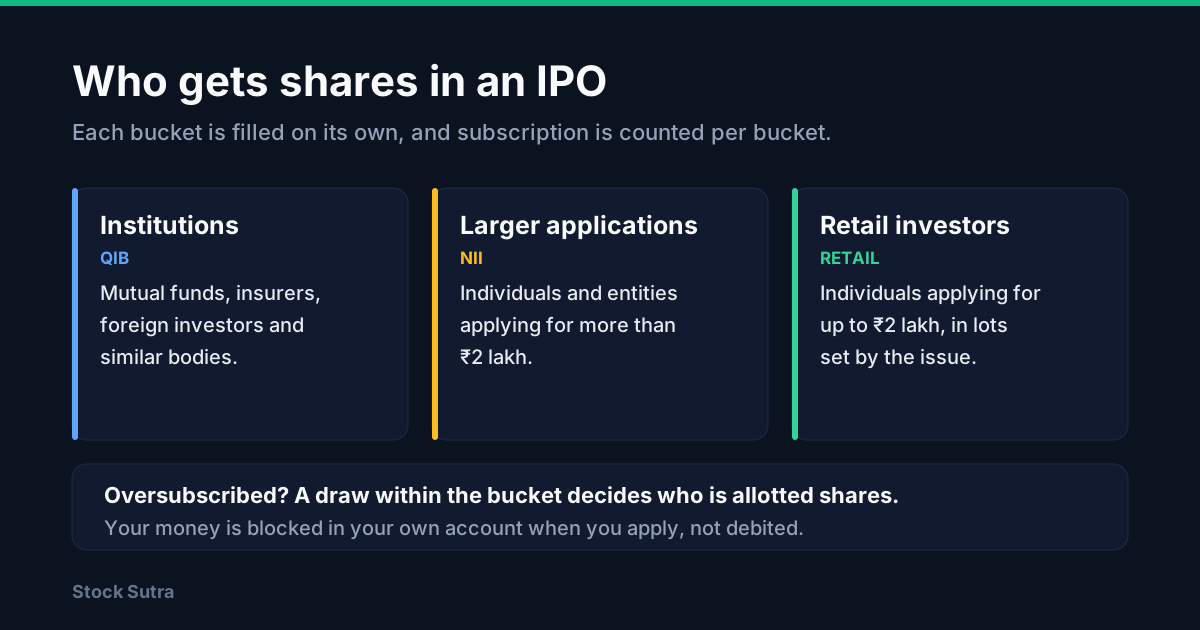
An IPO allotment is the process that decides who receives shares when more people apply than there are shares to give. It runs on fixed rules: shares are reserved for different categories of applicant, each category is filled separately, and when a category is oversubscribed a draw decides who gets the shares.
Knowing those rules removes most of the mystery. It explains why one applicant gets shares and another gets a refund, why applying for more lots does not help in some categories, and why "subscribed 50 times" does not mean what many people assume.
The three buckets that shares are split into
Shares in a book-built public issue are reserved before anyone applies. Each bucket is filled only by its own kind of applicant, and an unfilled bucket does not automatically spill into the others.
- Qualified institutional buyers (QIBs): mutual funds, insurers, foreign portfolio investors and similar institutions.
- Non-institutional investors (NIIs): individuals and entities who apply for more than ₹2 lakh. This bucket is further split by application size.
- Retail individual investors (RIIs): individuals who apply for up to ₹2 lakh.
The exact percentages for a particular issue are printed in its offer document, the red herring prospectus. A common structure reserves up to half for QIBs, at least a third for retail and the rest for NIIs, but the document for the issue in front of you is the only reliable source.
What a lot is, and why it matters
You cannot apply for a single share. Applications are made in lots: a fixed number of shares, set so that one lot costs roughly ₹14,000 to ₹15,000 at the upper end of the price band. A retail investor can apply for one lot at the minimum, and for as many as fit under the ₹2 lakh ceiling.
The price band is a range, for example ₹95 to ₹100. The final price, the issue price, is fixed after the book closes. Most retail applicants apply at the cut-off price, which means they accept whatever final price is set at or below the top of the band.
How you actually apply
Money is not taken from your account when you apply. It is blocked, not debited, through a facility called ASBA, and in practice through a UPI mandate that you approve on your phone. The blocked amount stays in your account, still earning whatever the account earns, until allotment is final.
After allotment:
- If you receive shares, the amount for those shares is debited and the rest is released.
- If you receive none, the whole block is released. No refund transfer is needed because nothing was taken.
What happens when the issue is oversubscribed
Each bucket's subscription is reported separately, and the number of times it is subscribed decides what happens inside it.
- Undersubscribed or just subscribed: everyone in that bucket gets what they applied for.
- Oversubscribed: the shares cannot cover every application, so the registrar has to choose.
In the retail bucket the choice is usually made by lottery. The aim is to give as many applicants as possible at least one lot, so the draw is among valid applications, not among rupees. This is why applying for the maximum number of lots does not improve your odds in an oversubscribed retail category: each valid application is one entry, whatever its size. The same logic is why applying many times from one account is not allowed, since duplicate applications on the same PAN are rejected.
In the NII bucket the allotment is typically proportionate to the amount applied for, with the details set out in the offer document. In the QIB bucket the company and its bankers have discretion within the rules.
Who decides, and when
The registrar to the issue finalises the basis of allotment, after the issue closes, and publishes it. The sequence follows a fixed timetable measured from the closing date:
- The issue closes and the registrar tallies valid applications.
- The basis of allotment is finalised and published.
- Shares are credited to the demat accounts of those allotted and blocked money is released for the rest.
- Trading begins on the listing day.
Current rules compress this into a few working days, but the exact timetable is stated in each issue's documents and has changed over the years, so treat any figure you read elsewhere as a snapshot.
What "subscribed 50 times" really means
The headline subscription figure compares the number of shares applied for with the number on offer. It is a total across buckets or a figure for one bucket, and the two can be very different. An issue can be heavily subscribed overall because institutions bid aggressively while the retail bucket was only lightly oversubscribed, or the reverse.
It is also a measure of demand at the time the book closed, not a measure of what the shares are worth once they trade. Subscription tells you how many people wanted shares at the issue price. It does not say what the market will pay afterwards.
Where to check the facts for a specific issue
Everything above is a general description. For a particular IPO the binding details are in the offer document and the exchange notices:
- The share of the issue reserved for each bucket
- The price band and the lot size
- The opening and closing dates and the listing date
- The registrar and the allotment status link
Frequently asked questions
Does applying for more lots increase my chance of allotment?
In the retail category of an oversubscribed issue, generally no, because the draw treats each valid application as one entry. Applying for more lots only ties up more money.
Is my money taken when I apply?
No. It is blocked in your own bank account through ASBA or a UPI mandate and released if you are not allotted shares or for the portion not used.
Can I apply twice using one PAN?
No. Multiple applications on the same PAN in the same category are treated as duplicates and rejected.
Why did I get no shares when the issue was only slightly oversubscribed?
Because oversubscription is measured per bucket. Your bucket may have been far more oversubscribed than the headline number suggests, so the draw left many valid applicants without shares.
What does "allotment" mean compared with "listing"?
Allotment is the moment shares are assigned to applicants and credited to demat accounts. Listing is the day those shares begin to trade on the exchange. They are separate events a few working days apart.