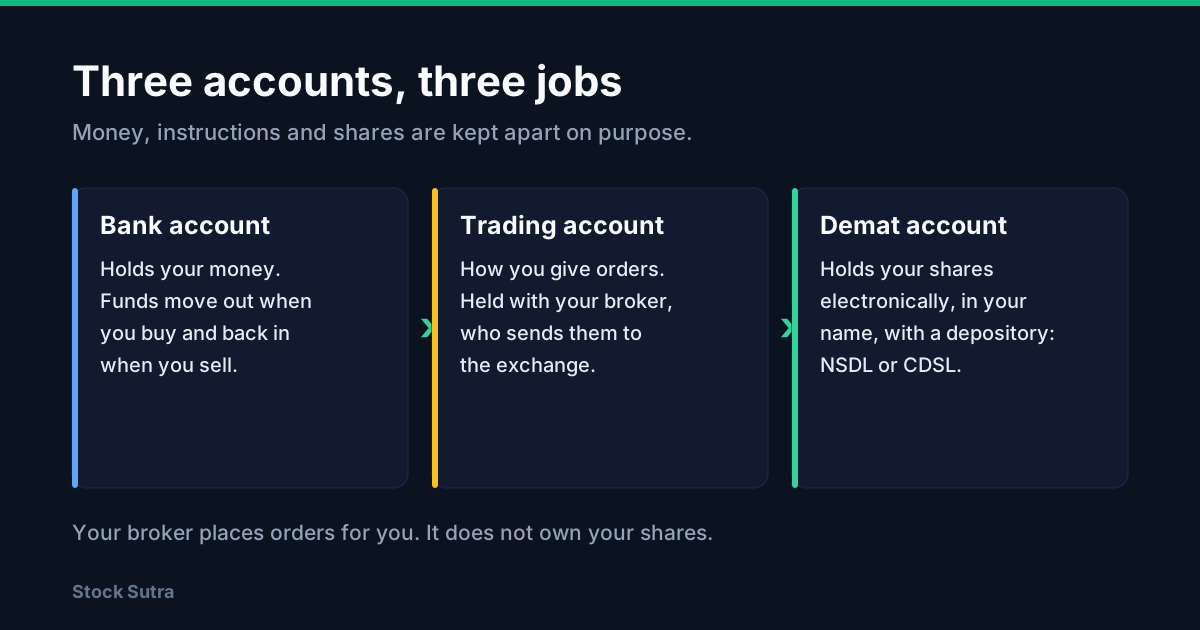
To buy a share in India you need three accounts that work together: a bank account, a trading account and a demat account. They do different jobs, and understanding who holds what makes the rest of the system easier to follow, from where your shares are kept to why a broker cannot simply take them.
The short version is that the bank account holds your money, the demat account holds your shares, and the trading account is how you give instructions.
The bank account: where the money is
Your bank account is an ordinary savings account. When you buy shares, money moves out of it. When you sell, the proceeds move back into it. For public issues, the money is blocked rather than moved until allotment, through a facility called ASBA, which in practice you approve with a UPI mandate.
Your bank is linked to your trading account, so that the broker can collect payments and return proceeds to the correct account. This link is why you must use your own account for these transfers.
The demat account: where the shares are
Shares in India are not held on paper. They exist as electronic records in a demat account (dematerialised account), kept with a depository. There are two depositories, NSDL and CDSL, and they are regulated entities whose job is to record who owns which securities.
You do not open an account with the depository directly. You open it through a depository participant (DP), which is usually your broker or a bank. The DP is the intermediary, but the record of your ownership sits with the depository.
Two consequences follow:
- Your shares are in your name. The depository records you as the beneficial owner. A broker holding your demat account for you does not own your shares.
- Your holdings survive a change of broker. Because the records are with the depository, you can move to another broker and bring your shares with you.
A demat account has a unique number: your client ID, together with the ID of the DP that holds it, forms the full account number used when shares are transferred.
The trading account: how you place orders
The trading account is your account with the broker, the member of the exchange that sends your orders to it. When you log in to an app and press buy, the order goes through your trading account to the broker, then to the exchange.
The trading account does not hold your shares or your money for the long term. It holds your records of orders, trades and the funds you have made available for trading. After a trade, the shares are delivered into your demat account and the money flows through your bank.
How a purchase moves through the three
- You have money in your bank account and link it to your trading account.
- You place a buy order through your trading account.
- The exchange matches the order, and the trade settles after one working day.
- The money leaves your account through the broker's settlement, and the shares are credited to your demat account.
A sale reverses it: shares leave the demat account, and money returns to the bank account via the trading account.
Why they are set up as three
The separation protects you. Your money sits with a bank, your shares sit with a depository, and the broker, which places orders and holds neither for the long term, cannot treat them as its own. If a broker fails, the shares in your demat account are still recorded in your name with the depository.
Since a rule change in 2020, a broker can also not use your shares as security without your explicit instruction. Pledging shares for margin is now done by you, through the depository, with an authorisation that you give for that purpose.
Many people open them together
In practice, brokers and banks often offer a three-in-one account, where the bank, trading and demat accounts are opened together and linked. It is the same three accounts and the same separation of roles, only with a smoother process.
You can also have more than one trading account or demat account, and the accounts can be with different institutions.
Keeping your accounts in good order
A few details matter more than they seem:
- Nominee: naming a nominee on the demat account lets your holdings pass smoothly to someone you choose.
- KYC: your identity records must be complete and up to date, or your accounts may be restricted.
- Contact details: a current mobile number and email are the channels for statements and alerts about your holdings.
Where to check the facts
- Your demat statement from the depository or DP, which lists exactly what you own
- Your broker's contract notes, showing each trade
- The depository websites, NSDL and CDSL, for how to check and manage holdings
Frequently asked questions
What is the difference between a demat account and a trading account?
A demat account holds your shares electronically. A trading account is how you place orders with a broker. You need both to buy and sell shares.
Who actually holds my shares?
The depository, NSDL or CDSL, records you as the owner. Your broker or bank is only the intermediary that provides the account.
Can I switch brokers and keep my shares?
Yes. Because the ownership records are with the depository, shares can be moved to a demat account with another participant.
Do I need three separate accounts?
You need all three roles. Many providers open them together as a three-in-one account.
Can my broker sell my shares without my permission?
A broker cannot use your shares as security or sell them without proper authority from you, and the rules require explicit authorisation for actions such as pledging.