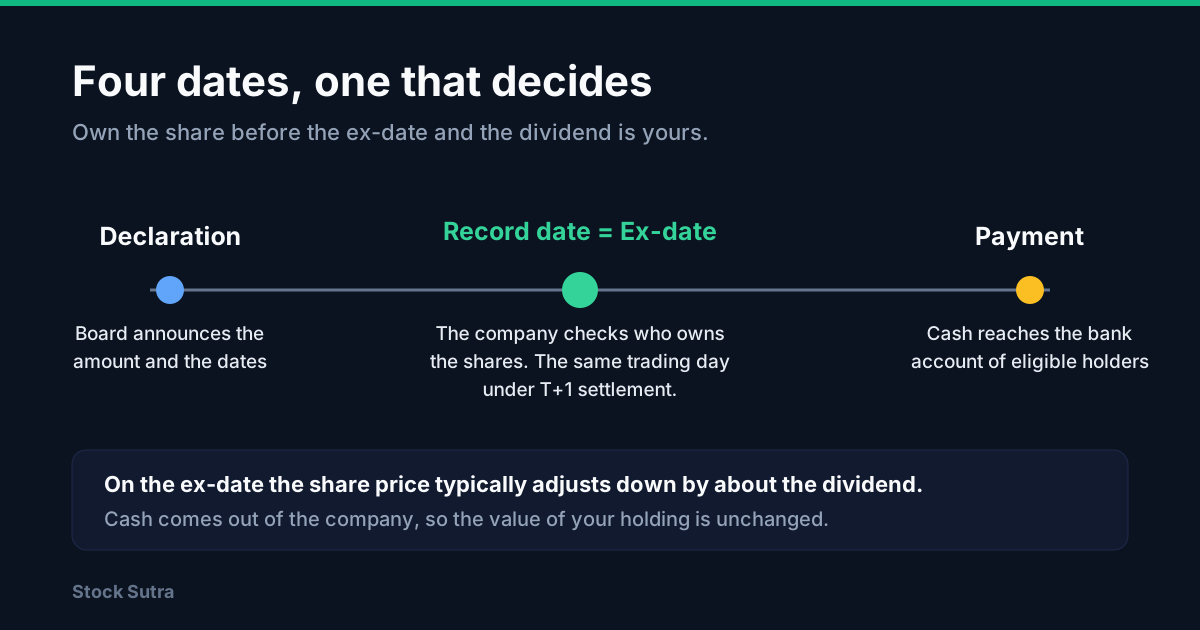
A dividend is a share of a company's profit that it pays out to its shareholders. The amount is declared per share, and the right to receive it depends on one thing: whether you are on the company's list of shareholders on a specific date. Everything else, the dates, the price drop and the payment, follows from that single rule.
The terms trip up many investors: the declaration, the record date, the ex-date and the payment date. They are four separate moments, and only one of them decides whether you receive the dividend.
The four dates
Declaration. The board announces the dividend, the amount per share and the record date. Final dividends usually need shareholders' approval at the annual general meeting. Interim dividends can be declared by the board during the year.
Record date. The company fixes a date on which it checks who its shareholders are. If your name is on the register that day, you receive the dividend. If not, you do not.
Ex-date. The first trading day on which a new buyer is no longer entitled to the dividend. A share that trades "ex-dividend" is priced without it.
Payment date. The day the money is actually paid into the bank accounts of the eligible shareholders. This is usually a few weeks after the record date.
Why the ex-date and record date are now the same day
The ex-date exists because of settlement. To be on the register on the record date, you must already own the shares in your demat account by then, and a purchase only reaches your account when it settles.
When India settled trades two working days after the trade, a buyer had to buy at least two days before the record date. The ex-date therefore fell one working day before it. Since the move to T+1 settlement, where trades settle one working day after, the ex-date and the record date fall on the same trading day. Older explanations that put the ex-date a day before the record date describe the earlier system.
The practical rule is simple: to receive a dividend, own the shares before the ex-date. Buy on or after the ex-date and you do not receive it.
What happens to the share price
On the ex-date, the share typically opens lower by roughly the amount of the dividend. The reasoning is straightforward: the company is about to hand out cash, so the business is worth that much less, and a buyer who will not receive the dividend should not pay for it.
This means a dividend is not free money added on top of your investment. If a ₹100 share pays a ₹5 dividend, the price tends to adjust to about ₹95, and you hold a share worth ₹95 plus ₹5 in cash. Your total is unchanged, apart from tax and from whatever the market does that day. In practice other factors move the price too, so the drop will not match the dividend exactly.
Dividend yield and what it does not tell you
Dividend yield is the annual dividend per share divided by the current share price. A ₹5 dividend on a ₹100 share is a 5% yield. It tells you how much cash a share pays relative to its price today.
It does not tell you that the dividend will continue. Companies can cut or stop dividends when profits fall or when they want to keep cash for growth. A yield can also look high only because the price has fallen, which is a different situation from a company paying generously out of strong profits.
A dividend is not the same as a bonus or a buyback
All three move value to shareholders, but they work differently.
- A dividend pays cash, and the share price falls to reflect it.
- A bonus issue gives extra shares at no cost, and the price adjusts in proportion.
- A buyback is the company purchasing its own shares from shareholders.
The article on splits, bonus issues and buybacks covers the last two.
Tax on dividends
Dividends received from Indian companies are taxed in the hands of the shareholder, and companies deduct tax at source above a limit set in the law. The rates, the limit and the treatment have been changed more than once, so the current rule should be read from the tax authority or a tax professional, not from an older article.
Where to check the facts
For a specific company, the dates and the amount are in:
- The corporate announcement the company files with the exchanges
- The corporate actions page on the exchange website
- Your broker's contract note and statements, which show the credit
Frequently asked questions
Do I get the dividend if I buy on the ex-date?
No. You must own the shares before the ex-date to be entitled to it. A purchase on the ex-date or later does not qualify.
Why does the share price fall on the ex-date?
Because the buyer will not receive the dividend, and the company is about to pay out cash. The price typically adjusts by about the amount of the dividend.
Is a high dividend yield always good?
It is only a ratio. A high yield can come from a falling price or an unsustainable payout, so it says little about whether the dividend will continue.
When is the dividend actually paid?
On the payment date, usually a few weeks after the record date, into the bank account linked to your demat account.
What is the difference between the record date and the ex-date?
The record date is the day the company checks its shareholder register. The ex-date is the first day a new buyer would not be on it. Under T+1 settlement they fall on the same trading day.